Confirmed > 99% Lab-grade Peptides
Acs Peptide Testing Laboratories Third-party Peptide Analysis
The table below web links typical project objectives to functional analytical panels and the type of choices they help support. Asparagine and glutamine deposits can go through deamidation, transforming the peptide's fee and hydrophobicity. Deamidation is one factor storage problems matter, especially after a peptide has actually been reconstituted. Every product we bring is lab-tested and validated by third-party companions, so researchers know specifically what they're collaborating with. Peptides including methionine or cysteine residues are vulnerable to oxidation. Methionine can be oxidized to methionine sulfoxide; cysteine can develop unwanted disulfide bonds or be oxidized to sulfinic or sulfonic acid derivatives.A functional assay determining downstream signaling-- or an architectural study utilizing NMR or X-ray crystallography-- requires the highest possible purity available. Crystallographers specifically frequently require ≥ 98% purity since also minor contaminants can protect against crystal development or introduce problem right into the crystal lattice. As molecules leave the column, they pass through a detector-- usually a UV detector readied to 214 or 220 nm, wavelengths where the peptide bond soaks up light strongly. The detector records just how much UV light is taken in over time, generating a graph called a chromatogram. This guide breaks down what purity actually indicates in peptide chemistry, just how it's gauged, what the contaminations are, and just how to read the documents that shows a peptide is what it asserts to be.
In basic terms, a peptide detailed as 95% pure consists primarily of the target peptide (95%), with the staying ~ 5% comprised of contaminations. These contaminations can consist of things like reduced or trimmed series, removal variants, oxidized residues, or other small side-products from the synthesis procedure. Peptides are widely used in the clinical aesthetic appeals, cosmetics, and biomedical areas due to their distinct organic task and broad application potential. Nevertheless, the high quality of peptide products directly affects their effectiveness and safety and security, making precise quality screening solutions essential.Understanding Peptide Pureness Screening
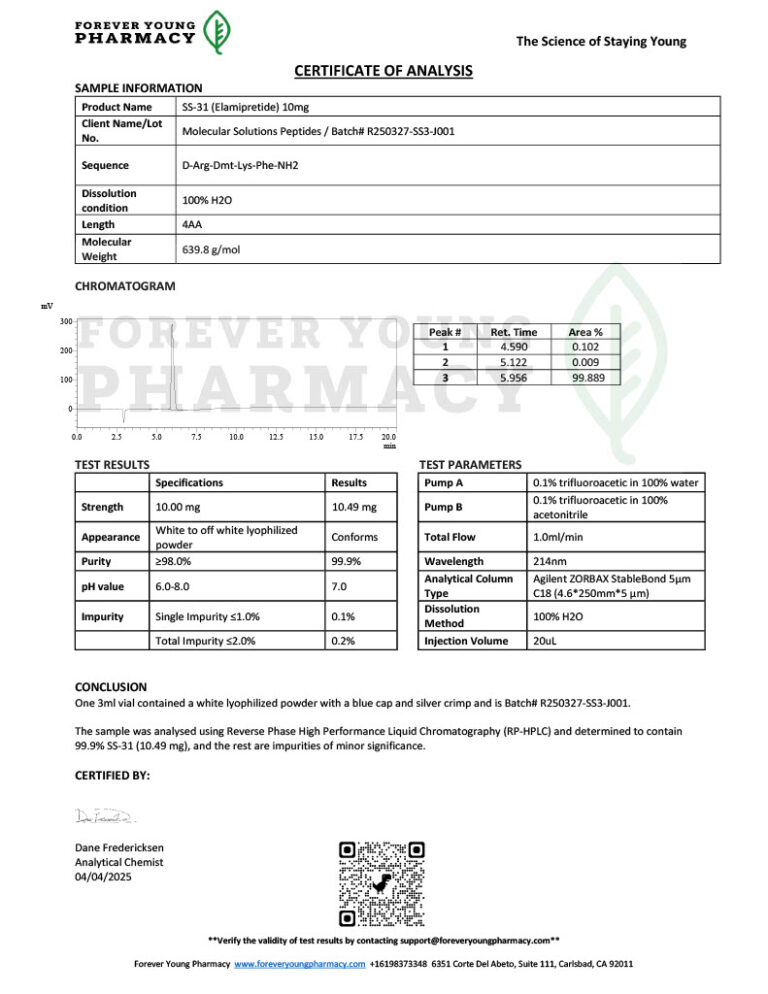
This level of thorough evaluation guarantees the peptide's accuracy-- indicating the sequence and purity are exactly as identified-- which is essential for experimental reproducibility. By validating structure through numerous verified techniques, laboratory recognition warranties that scientists receive a high-purity peptide that will do as expected in the laboratory. Research laboratory recognition of peptides is not just a scientific best method-- it's commonly a governing demand when peptides are utilized in healing growth or medical research study.
- Testing enables scientists to comprehend exactly what remains in the vial, verifying both identification and top quality.
- If you've ever obtained a synthetic peptide for a laboratory experiment, you have actually likely observed a purity percent on the certificate of analysis-- commonly values like 95%, 98%, or perhaps 99%.
- Guaranteeing that each set undertakes correct laboratory testing helps validate the peptide's authenticity and purity, which is crucial for both study credibility and safety and security.
- We can provide specialist peptide pureness decision services making use of logical reversed-phase HPLC coupled with mass spectrometry.
- Not every application needs 99% purity, and filtration is a considerable component of peptide manufacturing cost.
- Products are for in-vitro lab study usage only and are except human consumption.
FDA and the European EMA have developed standards mandating complete analysis and quality assurance for peptide items to ensure safety and security and effectivenessr. In the context of pharmaceutical or clinical-grade peptides, research laboratory recognition is essential to meeting these guidelines. As an example, prior to a peptide medicine can go into human tests, its producer must show the identification, purity, potency, and safety of the peptide with confirmed logical methods. Peptide pureness screening data are obligatory in preclinical research studies and should be consisted of in investigational brand-new medication (IND) applications and later brand-new drug applications (NDAs).
Applications Of Our Expert Peptide Testing Solutions
While peptide purity isn't the only aspect, making use of badly defined reagents is an acknowledged contributor to irreproducible results. For a 10-residue peptide with 99.5% coupling performance, you would certainly anticipate concerning 95% of the end product to be the full-length sequence prior to filtration. For a 30-residue peptide at the exact same effectiveness, that drops to roughly 86%. This is why much longer peptides are harder to create at high purity and typically cost more. Pureness is the percent of publications in the shipment that have every page published properly, in the right order, without any missing phases and no added pages packed in. A 95% pureness implies that out of every 100 "books" in your set, 95 are best copies and 5 have some type of error.
These can be especially troublesome because their chromatographic actions is extremely comparable to the target peptide, making them harder to divide throughout purification. When a peptide is 98% pure, that remaining 2% isn't random noise-- it specifies, recognizable kinds of by-products. Mass spectrometry gauges the molecular weight of a compound with severe precision. For peptides, the most common techniques are electrospray ionization (ESI-MS) and matrix-assisted laser desorption/ionization time-of-flight (MALDI-TOF). HPLC separates a combination into its private elements based upon how each particle connects with a specially developed column.
For researchers, obtaining confirmed peptides isn't simply a procedure-- it's the foundation of trustworthy experiments and study reproducibility. Poor-quality peptides (those with undiscovered contaminations, inaccurate sequences, or broken down elements) can result in misleading data and irreproducible results. As a matter of fact, proteins and peptides are among the most widely used lab reagents, yet researches have revealed that their quality is typically insufficient, resulting in poor information reproducibility. Beginning with appropriate laboratory validation is for that reason a crucial part of a scientist's quality assurance process.